Three journeys. Twenty-one stages. One infinite Self.
Every meditator knows the experience: you sit down, close your eyes — and the mind begins. The lists, the memories, the restlessness, the strange pull toward anything else. What if that chaos is the beginning? What if every state you pass through in meditation — the frustration, the focus, the sudden stillness — has a name, a meaning, and a teaching?
The 21 Stages of Meditation is a KRI-certified program that gives you exactly that: a precise, living map of the meditative journey. Developed by Gurucharan Singh Khalsa, Ph.D., and rooted in the teachings of Yogi Bhajan, it traces the full arc of contemplative experience — from the earliest turbulence of an untrained mind to the luminous, boundless state known as The Infinite Pulse. For students of Kundalini Yoga who have moved beyond the basics and are ready to understand what is actually happening when they meditate, this program is a revelation.
And there is a question at the heart of it all: Why do we practice? The answer, as this program makes clear, is happiness — the kind that comes from knowing yourself.
What the 21 Stages of Meditation Actually Maps
The 21 Stages of Meditation goes beyond technique — it tells you where you are and where you’re going.
The 21 Stages gives language to experiences that practitioners often feel but cannot articulate. Why does a consistent practice sometimes feel boring, sometimes transcendent, sometimes unbearably still? Because every one of those experiences is a stage — recognizable, navigable, and meaningful. And unlike a map you study alone, this program guides you through each stage in community, with a trained teacher holding the space and the practices that make the recognition real.The program maps 21 distinct states of consciousness, organized into three journeys of seven stages each. Every stage comes paired with a specific Kundalini Yoga meditation designed to help you recognize and move through that particular state of awareness. This is what transforms practice into a path.
“Meditation may be best understood as progressive stages of growth, or journeys, that provide different ways of encountering and realizing your infinite and eternal Self.” — Gurucharan Singh Khalsa, Ph.D.
Each time you return, you are in a different place in your life — and the same stages will offer entirely different insights. The program rewards return visits with new depth.
The Three Journeys — A Complete Map of Meditative Consciousness
Each journey is a standalone 2-day training that can be completed in any order. Together, they form one of the most thorough and accessible maps of meditative consciousness in the Kundalini Yoga tradition. Students and teachers from all contemplative paths are welcome.
Journey 1 — Experience and Crystallize the Self
Stages 1–7
The first journey begins exactly where most practitioners begin: inside the noise. Before the Self can be known, it must be separated from everything that obscures it — reactivity, restlessness, subtle resistance, the mind’s endless commentary on itself.
Journey 1 is honest in a way that most meditation teachings are not. It names the difficulty rather than skipping past it. The first four stages — Upset, Boredom, Irritation, Frustration — are the actual terrain of early practice. Learning to move through them steadily is where the practice of presence actually begins.
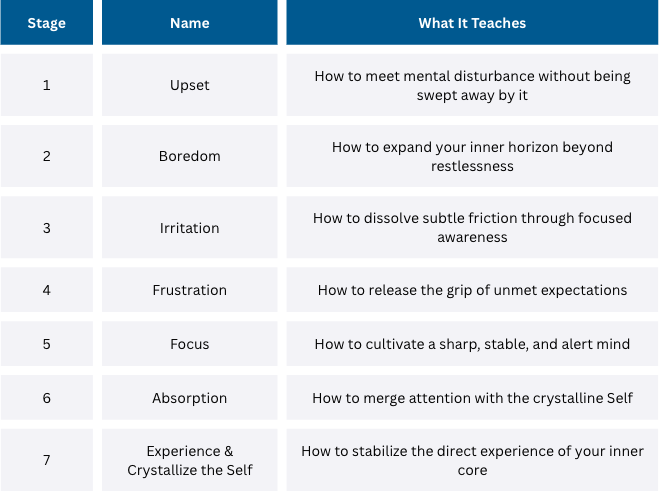
By Stage 7, what was once an abstract concept — the Self — has become a felt, stable reality. That is the work of Journey 1.
Journey 2 — Express and Distill the Self
Stages 8–14
Journey 2 explores what happens when you bring your Self into contact with the world — with other people, with roles, with expression and relationship.
These seven stages cultivate what might be called spiritual durability: the capacity to stay rooted in your essence even while you move through the full range of human experience. Qualities like grace, humility, and delight are meditative skills here — each with its own practice, its own recognition, its own depth.
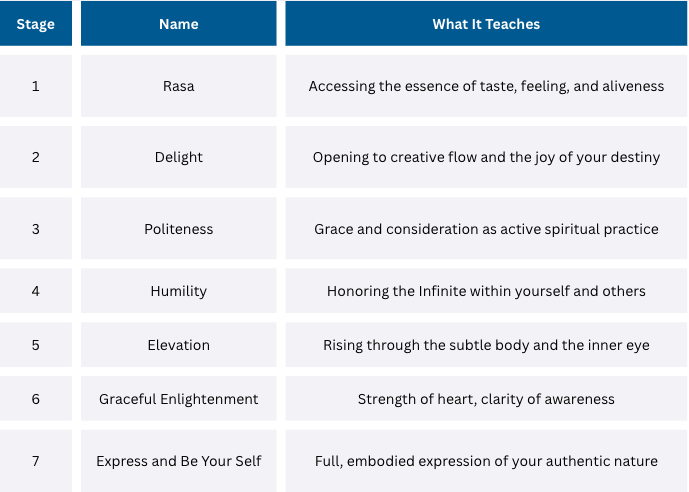
For teachers especially, Journey 2 is where the inner work becomes outer wisdom. It is the foundation for how you show up in the room: technically prepared and genuinely present — grounded in something your students can feel
Journey 3 — The Transcendent Self
Stages 15–21
The final journey takes the meditator to the edge of what language can hold. Limiting identity patterns dissolve. Intuition deepens and becomes reliable. The finite sense of self begins, stage by stage, to open toward something vaster.
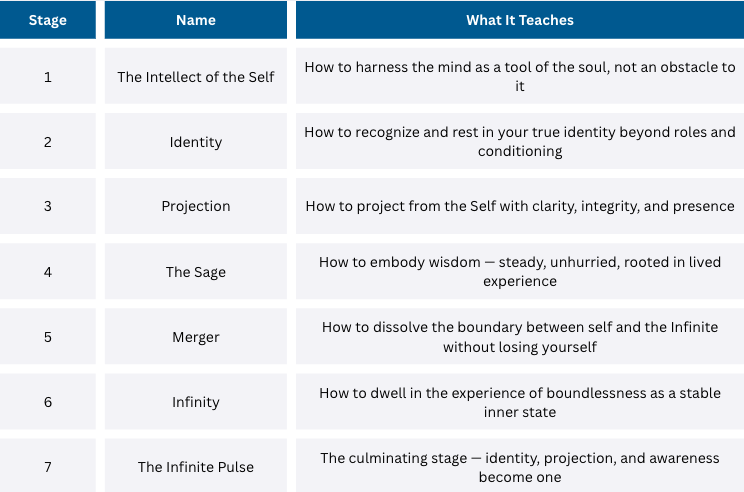
Journey 3 moves through progressive experiences of identity, projection, and merger — until arriving at Stage 21: The Infinite Pulse. This is the culminating state of the entire program: not a concept, but an experience. The crest of contemplative consciousness, where awareness, projection, and identity become one seamless whole.
The full teachings and meditations for all three journeys unfold in the live training — held by skilled teachers, and deepened by the presence of the group. This is an immersive experience that cannot be replicated alone.
A Program That Grows With You
The 21 Stages of Meditation is a living reference for your inner life — one that deepens with every return.
Practitioners who come back to the program — sometimes years later — find that the same stages speak differently. The frustration you once met with resistance you now recognize with curiosity. The absorption that once felt fleeting becomes something you can find your way back to. Each time you arrive at the training, you bring a different depth of experience, and the program meets you there.
This quality — the capacity to be returned to again and again — is part of what makes the 21 Stages one of the enduring programs in the Kundalini Yoga tradition.
Who Is This Program For?
The 21 Stages of Meditation is open to everyone. No prior certification is required to attend, and students from all contemplative traditions are warmly welcomed.
This training is especially powerful for:
Kundalini Yoga students with an established practice who want to understand the inner territory they are navigating — not just follow instructions, but recognize where they are and what each phase of practice is building toward.
KRI Teacher Training students pursuing Level 3 Certification who want a program that expands their own direct experience as much as their professional credentials.
Certified Kundalini Yoga teachers who are deepening their own practice and looking for the kind of nuance that makes them more effective guides — teachers who want to speak to their students’ inner experience because they know it from the inside.
Studio owners and training directors seeking qualified faculty. Teachers who have completed the 21 Stages bring a rare capacity: they can hold space for the full range of student experience — the confusion and the clarity, the resistance and the opening — because they have mapped it in themselves. Contemplative capacity is a hallmark of the Aquarian Teacher, and this program is one of the most direct paths to developing it.
Practitioners from other meditative traditions who are drawn to understand their own inner map with more precision. The 21 Stages offers a framework that is universal in its insight, even as it is rooted in the Kundalini Yoga lineage.
Certification and Continuing Education
The 21 Stages of Meditation is an officially recognized program within the Aquarian Teacher Training framework. Completing any journey earns a Certificate of Participation, and all three journeys contribute directly to your KRI credentials.
- Counts toward KRI Level 3 Certification — a central requirement of the Aquarian Teacher program
- CEUs recognized by IKYTA (International Kundalini Yoga Teachers Association)
- Each 2-day journey awards a Certificate of Participation
- Journeys may be completed in any order, at your own pace
- The program may be repeated — and many practitioners choose to do so
For organizations and training programs: teachers who have completed the 21 Stages can speak to the inner map of meditation with a precision that benefits students at every level — beginners who need context for what they’re experiencing, and advanced practitioners who are ready for something more.
About the Program — Gurucharan Singh Khalsa, Ph.D.
The 21 Stages of Meditation was originally articulated by Yogi Bhajan and elucidated in full by Gurucharan Singh Khalsa, Ph.D. — one of the most respected voices in the practical application of Kundalini Yoga and meditation for human development since 1969.
Gurucharan Singh serves as director of Kundalini Yoga Teacher Training programs and is an affiliated scholar at Chapman University’s Institute for Quantum Studies in California, where his work bridges contemplative practice and the science of consciousness. His approach to the 21 Stages is precise without being clinical, and profound without being abstract — a rare combination that makes this among the most accessible deep-dive programs in the Kundalini Yoga tradition.
“Make meditation the art of life. Make meditation the science of life. Because only with that, and with that only, can you develop intuition.” — Yogi Bhajan, July 20, 1978
Frequently Asked Questions
No prior experience is required. This program is genuinely open to all levels — but it tends to land most deeply for practitioners who have already developed some consistency in their meditation practice. If you sit regularly and you’re ready to understand what is actually happening when you sit, this program will meet you there.
The three journeys can be completed in any order. Each is a standalone 2-day training with its own complete arc. Many practitioners find that whichever journey they begin with is exactly the one they needed first.
Absolutely — and many practitioners do. Each time you return, you arrive with a different life behind you, and the stages open up from a different angle. The program rewards every return with new depth and new recognition.
Yes. The 21 Stages of Meditation contributes to KRI Level 3 Certification and qualifies for CEUs with IKYTA. It is one of the central requirements of the Aquarian Teacher Training Program.
The Infinite Pulse is Stage 21 — the culminating state of the entire 21 Stages of Meditation journey. It is the description of a direct experience: a state of consciousness in which identity, projection, and awareness merge — where the boundary between the individual self and something much vaster becomes, for a time, transparent. It is what the entire map has been pointing toward.
Yes. IKYTA encourages training directors and studio owners to explore how the 21 Stages can deepen their faculty’s preparation and their students’ experience. Contact us directly to discuss how to incorporate the program into your training offerings.
Begin the Journey Into Your Own Depths
You have been practicing. You know something is happening inside — states with names you have yet to learn, depths that are ready to be mapped. The 21 Stages of Meditation gives you the language and the path.
Three journeys. Twenty-one stages. A lifetime of clarity.